Tampilkan postingan dengan label Prossecor. Tampilkan semua postingan

Jumat, 31 Juli 2009

About Nehalem Microarchitecture?

We have known for a long time that in 2008 we will see Intel processors on new microarchitecture. We first learned about it two years ago, when Intel introduced their “Tick-Tock” concept, according to which we get new processor manufacturing process or new microarchitecture every year. Last year, Intel introduced Penryn processor family that was a refresh of Core microarchitecture: these CPUs were made with 45nm process using hafnium-based high-k dielectrics. Therefore, this year we should see new Nehalem microarchitecture represented by desktop Bloomfield processors.
Alternating new manufacturing process with the development of new microarchitectures allowed Intel to avoid delays with new processor launches. That is why a year from the announcement of Penryn processors we are ready to talk about processor innovations again: the launch of CPUs with Nehalem microarchitecture is getting closer day by day.

Taking into account how important this event actually is, we decided to split our review of this long-anticipated solution into several parts. Today we are going to talk about the technological and architectural peculiarities of Nehalem microarchitecture and in a few days we will offer you analysis of Nehalem performance in real applications and discussion of its other practical features.

General Principles of Nehalem Microarchitecture

Before we get acquainted with a promising Nehalem microarchitecture, we would like to say a few words about the reasons for its arrival. Although they have been working on it for a long time, Intel hardly intended to announce CPUs based on it only for the sake of sticking to their own “Tick-Tock” schedule. It seems that even though Core microarchitecture has been extremely successful, there is something about it that doesn’t quite satisfy the microprocessor giant any more. And these reasons are not superficial. Core processors have a lot of advantages, sell very well and are way ahead of the competitor’s solutions.

It turns out that a serious drawback of Core microarchitecture that makes Intel very unhappy is their non-modular design. Being a continuation of the mobile Pentium M CPUs, Core 2 microprocessors were initially designed as dual-core semiconductor dies. When they started making multi-core Core 2 and Xeon solutions later on, they discovered several drawbacks of this approach. Quad-core and recently released 6-core processors on Core microarchitecture were simply composed or several dual-core dies that had difficulties communicating with one another. Separate cores exchanged data through system memory, which resulted in serious delays caused by limited processor bus bandwidth.

Another bottleneck surfaced in multi-processor systems. Although Intel had already solved the problem of sharing the system bus between processors by launching new chipsets providing an individual bus to each processor, the performance of these systems would often be limited by insufficient memory bus bandwidth. We could see this problem even in Skulltrail platform targeted for computer enthusiasts, not to mention high-performance workstations and servers.

In other words, increasing the systems performance by adding more processor cores to CPUs and more processors to the systems would have sooner or later brought Intel to a dead end, despite the fact that contemporary Core microarchitecture seemed very successful overall. That is why Intel is working real hard to switch to new Nehalem microarchitecture that solved the above described structural problems in the first place. Nehalem’s key peculiarities that immediately catch your eye are integrated memory controller and new bus with point-to-point topology called Quick Path Interconnect (QPI) that not only connects the processor with the chipset but also connects directly several CPUs with one another.

All these innovations remind us of the AMD processors’ structure: a few years ago AMD discovered the advantages of integrating the memory controller into the CPU and connecting the CPUs with one another in multi-processor systems. However, even though Intel is currently the one catching up, Intel CPU cores have been offering higher performance since the launch of Core microarchitecture.

Nehalem’s second important innovation is the modular CPU design. In fact, the actual microarchitecture consists only of a few building blocks that will be used to form a processor at the final design and production stage. This set of building blocks includes a processor core with an L2 cache, L3 cache, QPI bus controller, memory controller, graphics core, etc.


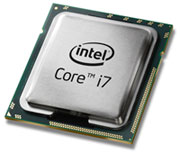
The appropriate blocks will be put together within a single semiconductor die and presented as a solution for this or that market segment. For example, the Bloomfield CPU we are going to discuss fairly soon consists of four cores, an L3 cache, a memory controller and one QPI bus controller.


Server processors with the same microarchitecture that should be announced in early 2009 will have up to eight cores, up to four QPI bus controllers for multi-processor systems, L3 cache and a memory controller. The upcoming budget Nehalem processors scheduled to come out in H2 2009 will have two cores, a memory controller, a graphics core and DMI bus controller connecting the processor directly to the South Bridge. These are far not the only possible modifications. We referred to them to illustrate how flexible Nehalem microarchitecture is.


New principles in platform and processor design are certainly a significant but far not the only innovation arriving with the new Intel microarchitecture. A lot of changes have been made to the main part of a CPU: its computational core. Although Nehalem processor cores may be regarded only as enhanced cores with Core microarchitecture, they still support a lot of new technologies and boast numerous improvements. They provide Nehalem processors with higher “pure” performance. Among important innovations we should mention SMT (Simultaneous Multi-Threading), which is similar to Hyper-Threading technology that allows processing two computational threads simultaneously in a single core. We should also point out support of new SSE4.2 instructions, more efficient branch prediction algorithms, larger internal buffers, more efficient and faster cache-memory.

Summing up everything we have just said, let’s once again list the major distinguishing features of the new CPUs from Nehalem family:

* Two, four or eight cores;
* More advanced computational cores than those of Core based processors;
* SMT technology that allows processing two computational threads simultaneously in a single core;
* Three levels of cache-memory: 64KB L1 cache per core, 256KB L2 cache per core, up to 24MB shared L3 cache;
* Integrated memory controller supporting several DDR3 SDRAM channels;
* Monolithic design: the CPU consists of a single semiconductor die;
* 45nm production process;
* Possibility to integrated a graphics core into the CPU;
* New QPI bus with point-to-point topology connecting the processor with the chipset or the processors with one another;
* Modular structure.

Now that we have briefly discussed the general concept of the new microarchitecture, let’s take a closer look at the individual parts of the CPU based on it.


Readmore>>http://www.xbitlabs.com/articles/cpu/display/nehalem-microarchitecture_2.html

Intel Nehalem will be launched soon


Intel appears to be preparing the launch of the newest security chip, which according to the plan will be ready in August to come. Latest Intel processor chip will implement this architecture Nehalem design with a more promising performance for all types of computers, from laptops, desktop to server.

The latest chip technology from Intel is designed to be able to overcome the bottleneck problem that is very in the performance of each processor. In addition, this technology also Nehalem chip can execute more tasks to the needs of the power consumption is lower.

According to Digitimes, the chip giant will begin implementing the micro-architecture design of a new series on this new desktop and laptop on board, starting in September is akan datang. Intel will launch the desktop quad-core processor with the code-name Lynnfield in early September, then followed with a laptop processor with quad-core code-name Clarksfield on next weekend. This second processor, the Lynnfield and Clarksfield are made with 45 nanometer technology practice, the next plan will make it to the Intel 32 nanometer technology.

In addition, Intel will also launch the processor chip for the newest class ultra thin laptop, the SU2300 and Celeron Celeron 743 in September to come.

Encore, Save Energy New Processor Has Been Developed


Scientists at a university in Scotland has made a microprocessor that can create energy MP3 player and mobile phone 4g more efficient. Encore, the microprocessor that provides faster, but using the power and storage space is less than the same devices in the market. Meanwhile, scientists at the University of Edinburgh is to save the microprocessor a silicon chip to run the prototype in the lab.

Professor Nigel Topham's School of Informatics, University of Edinburgh at the same time develop a microprocessor Encore, revealed that this project developed from the computer, and feel happy because the chip is able to work with stable and with low power consumption. "If this device is used in the mobile phone will increase the durability of batteries, although not yet known how long it is able to survive. This processor has a low consumption compared to other commercial processor, and the user can customize processor and add the applications that can run. "Topham said.

Encore microprocessor hardware devices have been developed during the 4 years as part of a project sponsored by the Engineering and Physical Sciences Research Council (EPSRC), to investigate the development of new methods of computer devices.

More info>>

Scientists at a university in Scotland has made a microprocessor that can create energy MP3 player and mobile phone 4g more efficient. Encore, the microprocessor that provides faster, but using the power and storage space is less than the same devices in the market. Meanwhile, scientists at the University of Edinburgh is to save the microprocessor a silicon chip to run the prototype in the lab.

Professor Nigel Topham's School of Informatics, University of Edinburgh at the same time develop a microprocessor Encore, revealed that this project developed from the computer, and feel happy because the chip is able to work with stable and with low power consumption. "If this device is used in the mobile phone will increase the durability of batteries, although not yet known how long it is able to survive. This processor has a low consumption compared to other commercial processor, and the user can customize processor and add the applications that can run. "Topham said.

Encore microprocessor hardware devices have been developed during the 4 years as part of a project sponsored by the Engineering and Physical Sciences Research Council (EPSRC), to investigate the development of new methods of computer devices.

More info>>

Info Samsung Hummingbird


Intrinsity and Samsung have worked together to prepare for the fastest processor that is intended for devices like the Apple iPhone. Processor chip developed by Samsung and Instrinsity based in Austin, Texas is the same as the processor in the iPhone 3GS, the ARM Cortex A8 processor 600MHz. Company to license ARM chip design sparing energy now have started to use by chip suppliers, including Samsung, Texas Instruments, Qualcomm, and Nvidia.

Fastest chip processor and Samsung's creation is given a name Intrinsity Hummingbird, which later can be applied in the iPhone or similar device. "Samsung to create a Hummingbird in S5PC100 with the design without any changes. Previously, the design is already in S5PC100 iPhone 3GS, and for the next edition of iPhone will have a clock speed up to 1GHz. "Said Tom R. Halfhill, senior analyst of the Microprocessor Report.

Halfhill added that Samsung will use the Hummingbird for smartphone of the future, especially for future Apple devices. One advantages of this chip Hummingbird is associated with the clock speed, something that is not supported in the design of ARM, where the ARM chip speak concerning power efficiency, not high performance.

"However, it has now changed, Design core mobile processor more focused on performance, high clock speed, and energy efficiency." Pillowslip Jae Cheol Son, vice president Soc Development Platform, from Samsung Electronics. Hummingbird In this chip, to obtain the 1GHz clock speed required 45nm manufacturing process, is smaller than the chip that uses the current 65nm process. The smaller, more rapid and more efficient use of energy. Hummingbird chip concept is possible to use the mobile application processor or main processor in the smartphone starting in 2013.

Jumat, 17 Juli 2009

Enter The Dragon: AMD Phenom II X4 940

AMD has been fighting an uphill battle on two fronts for the last few years. For a time, fierce competition from NVIDIA, coupled with some of their own problems executing, put the ATI graphics division in a deep hole. And ever since the introduction of the original Core 2 processors , and more recently the Core i7, AMD's processor division has fallen well behind Intel in terms of overall performance.

Starting in November of 2007 though, we got a sense that AMD was slowly, but surely, clawing its way back into the fight. It began with the introduction of the Spider platform, which consisted of AMD's native quad-core Phenom processors, 7-series chipsets, and 3800-series graphics cards . Individually, the components that made up the Spider platform weren't performance leaders in their respective categories, but ultimately the platform proved to be solid, and of course, it was priced very competitively. The introduction of Spider also marked the first time AMD could offer an entire desktop platform consisting only of AMD-branded processors, core logic, and graphics.


As many of you know, AMD hasn't been sitting idle since the Spider platform introduction. The company's chipset division has launched a handful of new chipsets, featuring one of--if not--the best IGPs on the market and a new Southbridge, the SB750, that allows for higher overclocks through the use of ACC, or Advanced Clock Calibration. The ATI graphics division has also been firing on all cylinders lately, having released a top to bottom lineup of GPUs that compete very favorably at their respective price points. AMD also recaptured the 3D performance crown from NVIDIA for a time with the Radeon HD 4870 X2. AMD wasn't going down without a fight.

With the chipset and graphics divisions on a roll, it was time for the CPU team to pull the trigger on something new and exciting, to complete the new platform trifecta. It took some time, but that's exactly what's happening today. The end result is the Dragon platform which consists of new 45nm Phenom II X4 processors, 7-series chipsets, and ATI Radeon 4000 series graphics cards. We've got the goods in house and will fill you in on all of the juicy details on the pages ahead; for now let's get some of the particulars and back-story out of the way...

More Info About The-Dragon-AMD-Phenom-II-X4-940 & Source file >>

Intel Core i7 Overclocking - A HotHardware How-To

Synopsis: Intel's Core i7 processor offers a significant performance increase over previous generation Core 2 processors. In addition, like the legacy Core 2 architecture, the new Core i7 also has a bunch more headroom for wringing upside performance out of the chip, maximizing value, power and return on your investment with overclocking. In fact, Intel actually built-in a predefined overclocking feature called "Turbo Mode". We explain how not only Core i7 Turbo Mode works but also how to manually

overclock the Core i7 in the BIOS as well as give you strategies on maintaining stability of the system as you ramp up the Core i7 core frequency for even larger gains in performance.
Test System and Equipment: In this video spotlight we're overclocking the Intel Core i7 processor on Digital Storm's 950Si custom Core i7 gaming system that utilizes EVGA's X58 3X SLI motherboard and Corsair Triple Channel DDR3 memory. Be sure to check out the Digital Storm and EVGA articles for additional details and a full review of the platform we tested on, as well as our Core i7 launch article, if you'd like a refresher on the chip-level technology we were working with in this HotHardware How-To.

More info&Source>>>

AMD Phenom II Hardcore Overclocking Event

Located in the heart of Texas, the city of Austin is known for many things. Nicknamed Silicon Hills, the state capital accommodates an army of tech companies including the one and only Advanced Micro Devices, better known as AMD. From May 20th to the 22nd, AMD brought in some of the biggest names in the extreme overclocking scene with the goal of breaking world records. Armed with AMD's latest Black Edition processor, the Phenom II X4 955, a steady flow of liquid nitrogen (LN2), and several vats of liquid helium (LHe), the stage was set for one of the most impressive overclocking exhibitions of recent memory.


The best of the best were on hand to push AMD's new silicon to the limit. Pictured from left to right - Vince Lucido (K|ngp|n), Brian McLachlan (chew*), Chris Morrell (Gomeler), and Matthew Sembinelli (Slappa).
As with all extreme activities, the bar is constantly raised as competitors find new ways to gain an edge. Until recently, liquid nitrogen was used exclusively by top overclockers to reach approximately -185 degrees Celsius in order to break records and set new high scores in benchmarks. Now, liquid helium is being used to bring temps down to about -235 degrees Celsius, enabling overclockers to push hardware even further than before.

Source>>

AMD Athlon II and Phenom II X2 Processors Debut

AMD is using the prominence of the Computex show in Taipei to unveil a slew of new, affordable desktop processors. A few of them are based on the existing core employed within their Phenom II processor line-up, but one of them is comprised of a new piece of silicon that pays homage to the once mighty Athlon brand.

We've got four new AMD processors on tap for this article, low power quad- and triple-cores, and a pair of new dual-cores. The 3.1GHz AMD Phenom II X2 550 Black Edition is positioned as AMD's fastest dual-core processor ever, while the Phenom II X3 705e is a low-power triple-core CPU. The Phenom II X4 905e is a low-power 65w quad-core, and the brand new Athlon II X2 250 is AMD's latest high-performance, budget-class dual-core processor.


All of these processors share some similarities, of course, but each one is positioned for a somewhat different market segment. Take a look at the specifications and features below, and then we'll move on to the juicy details...

Source>>

Intel Core i7 975 Extreme Edition Processor Review

When you consider Intel's recent success at introducing new, cutting-edge processor architectures as of late, you can't help but appreciate the fact that the company is executing extremely well. The cold, hard fact of the matter is, even their last generation Core 2 architecture competes admirably with AMD's most recent update of the Phenom II, dollar for dollar and clock for clock. In fact, Intel's Core 2 architecture has done so well, that further roll-out of Intel's newer Core i7 line-up has been limited, no doubt in part because Intel doesn't absolutely need their fledgling new chip architecture to compete vigorously with their rival. There's no question, AMD's Phenom II is a solid alternative to the Core 2 but playing catch-up to Intel's legacy architecture is still not a very exciting position to be in, obviously.
Thus far there have been a mere three different models of Intel's new Core i7 processor that have been released to any channel, OEM or retail - the Core i7-920, Core i7-940 and the flagship Core i7-965 Extreme Edition. With clock speeds starting at 2.66GHz and scaling to 3.2GHz, Intel's new Core i7 proverbially lights up anything from AMD's high end line-up right now, even comparing the chip's slowest speed bin, never mind at like clock speeds. That said, the semiconductor business is pretty much a ruthless and relentless game of one-upsmanship; or in Intel's case currently, perhaps its two or three-up. As such, you can be sure Intel is looking for another kill shot, whenever they can.

Today Intel is finally releasing new Core i7 models and speed bins to the market, as well as announcing a new flagship chip, the Core i7-975 Extreme Edition. Though it will definitely command a hefty price tag, at a stock clock speed of 3.33GHz and Intel Turbo Boost speeds at 3.45GHz (all cores) and 3.6GHz (single core), you can bet this new Core i7 is one hot-rod of a quad-core CPU. In the pages ahead, we'll wind it out around the test track and show you what the fastest desktop processor on the planet can do when it's tuned up for a touch more horsepower at the factory and made ready for production.

More Info>>

Intel Core 2 Quad Q8400 CPU Review

It was not too long ago that the web was buzzing with dual-core versus quad-core debates. Sides were taken and lines were drawn. At that time, one of the main arguments against quad-core processors was their high asking price. But as time passed and manufacturing refinements were made, costs steadily decreased and quad-cores found their way into the more mainstream market segments. And before you knew it, a price war was imminent.

Intel and AMD have been going at one another for years. With AMD unable to compete well at the ultra high-end of the market, however, their focus shifted towards the mainstream market segments. As always, Intel responded and their most recent salvo comes in the form the affordable Core 2 Quad Q8400 processor. Since the Q9400, a 2.66GHz Yorkfield quad-core, was already on the market, why did Intel feel the need to release another, affordable quad-core model? One reason could be to increase yield and utilize dies that would otherwise be discarded. Another reason would be to position another product at the same price point as AMD's. Whatever the case may be, competition is always good for the consumer as it usually drives prices lower and provides more options to choose from. With that in mind, let's take a look at the Intel Core 2 Quad 8400 to see if it's worthy of consideration for your next build...


More Info>>

AMD Phenom II TWKR Black Edition Processor

Within the enthusiast scene, there exists an elite group of overclockers who push the limits of hardware to the breaking point. With the help of phase change coolers, dry ice, liquid nitrogen and even liquid helium, these enthusiasts achieve the seemingly impossible. In this world, maximum frequencies and world records are the motivation behind the countless hours spent modding and tweaking PC hardware.

AMD recognized the blood, sweat, and tears that extreme overclockers put into their hobby by creating a very special, limited edition processor made specifically for them. The Phenom II X4 TWKR Black Edition processor is a hand picked CPU that performs above and beyond the normal parameters we're accustomed to seeing from the Phenom II line. Under the extremely low temps supplied by LN2 or LHe cooling, these chips are said to yield monster overclocks.
So what's the catch? First of all, AMD only made a few TWKR chips due to the extraordinary traits of of the product. So don't expect to find any at your favorite online retailer cause the TWKR is not currently for sale. At this time, they are distributed directly by AMD. Another disadvantage is the lack of warranty coverage on this product. Once its broken, that's all she wrote. At any rate, HotHardware recently got a chance to test out the TWKR and throw it on the test bench for some sub-zero overclocking.

MORE INFO>>

Fave This

Your Ad Here